Title: A study of the overtopping breach of a sand-gravel embankment dam using experimental models
Year: 2021
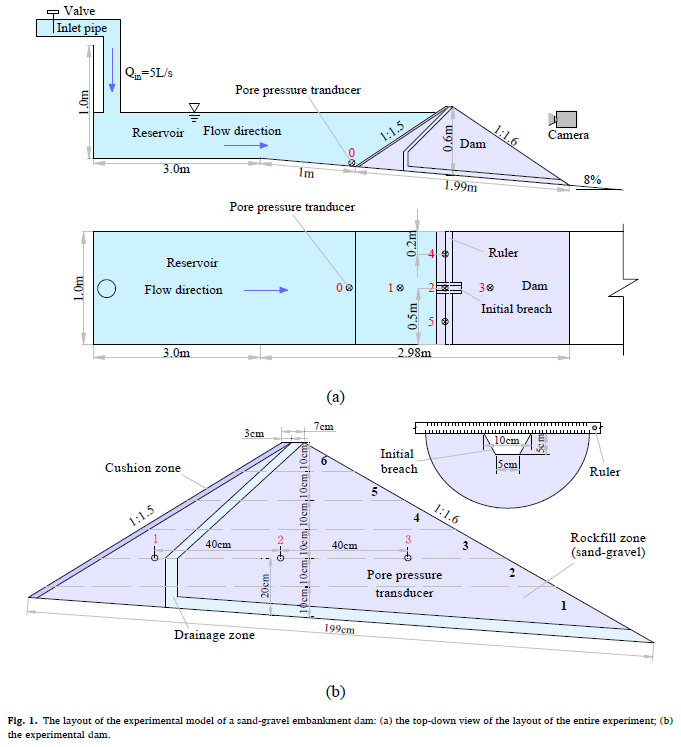
Content: Sand–gravel embankment dams are widely used because of their high stiffness and low porosity, but they are vulnerable to overtopping caused by floods, landslides, or surge waves, which may lead to breaching. This study conducted overtopping experiments on dams without an upstream face slab under three different initial seepage conditions to investigate breach development. The results indicate that the breaching process progresses through downstream slope erosion, gully formation, rapid breach enlargement, and final stabilization. A higher phreatic line and larger saturated zone accelerate breach expansion, increase peak discharge, and shorten breach duration, whereas a drainage zone helps mitigate and control the breaching process.
Title: Overtopping Breaching of Noncohesive Homogeneous Embankments
Year: 2002
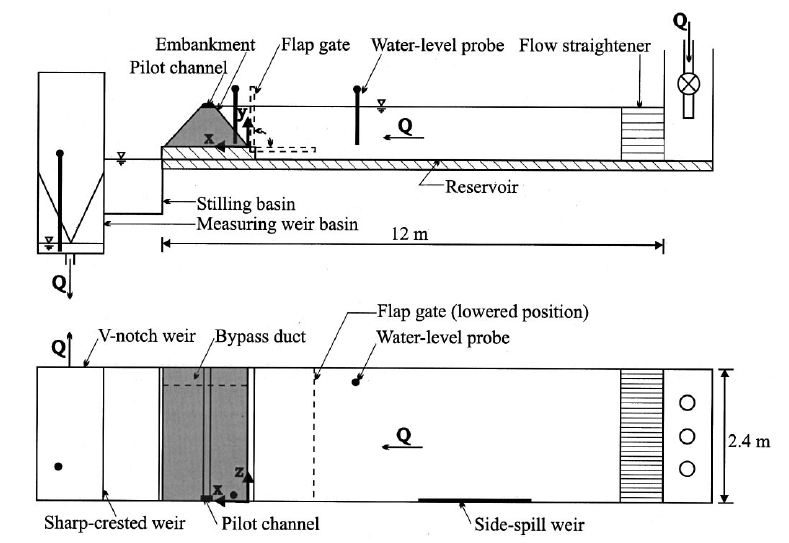
Content: Small homogeneous embankments made of uniform noncohesive materials were tested in flumes and failed by overtopping under constant water levels. The erosion process changes from mainly vertical erosion at the beginning to lateral widening over time. The breach initially forms on the downstream slope with a steep profile, then gradually flattens while rotating around a pivot point near the base, and the breach channel develops a curved (hourglass) shape in plan view. Empirical relationships were proposed to describe the breach cross-section shape and breach discharge as functions of crest height, water depth, and crest length. These results can be used to predict breach development, eroded volume, and flood discharge following embankment failure, although further validation is needed for larger-scale dams.

Title: Simulation of overtopping and seepage induced dike failure using two-point MPM
Year: 2020
Content: Fluvial dikes protect river valleys from flooding, so their stability is critical. This study uses a two-point, two-phase Material Point Method (MPM), implemented in Anura3D, to analyze dike stability under overtopping flow. The model simulates soil and water within a single coupled framework, allowing fully dynamic interaction between the two phases. The numerical results agree well with laboratory experiments, and parametric studies were conducted to evaluate different stability measures. The two-point MPM demonstrates strong potential for analyzing problems involving complex soil–water interactions.
Title: Prediction of Overtopping-Induced Breach Process of Cohesive Dams
Year: 2019
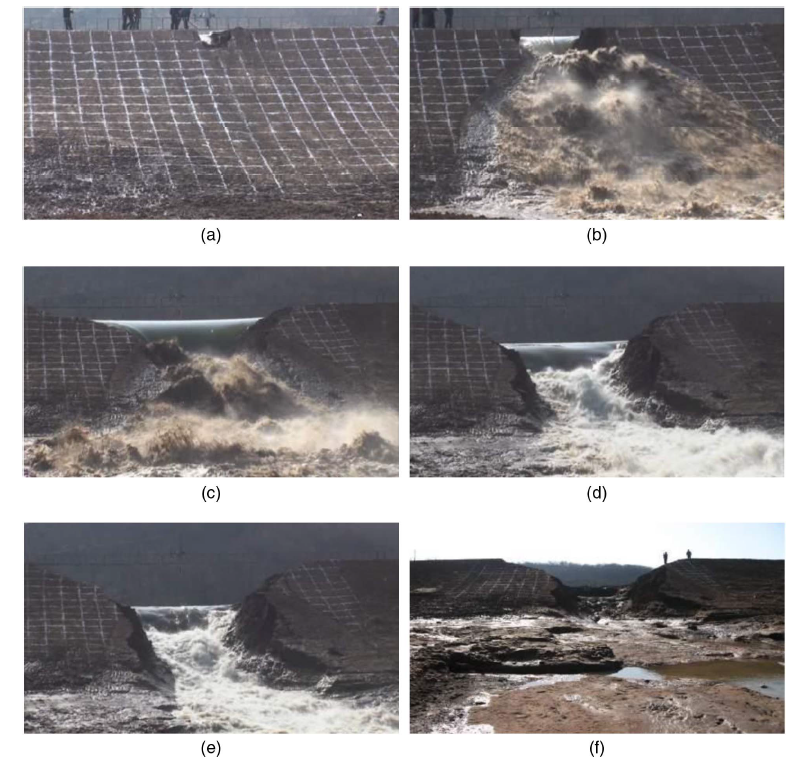
Content: Large-scale experiments at the Nanjing Hydraulic Research Institute identified surface erosion, intermittent mass failure along the dam axis, and headcut formation and migration as the main breaching mechanisms of cohesive dams under overtopping. Based on these mechanisms, a new numerical model was developed to simulate the overtopping process. Comparisons with three large-scale tests show that the proposed model performs better overall than other physically based models. Sensitivity analyses indicate that all models are strongly influenced by soil erodibility, with the proposed model and WinDAM B being more sensitive than the NWS BREACH model. The proposed model also provides more detailed and accurate results than commonly used parametric models.