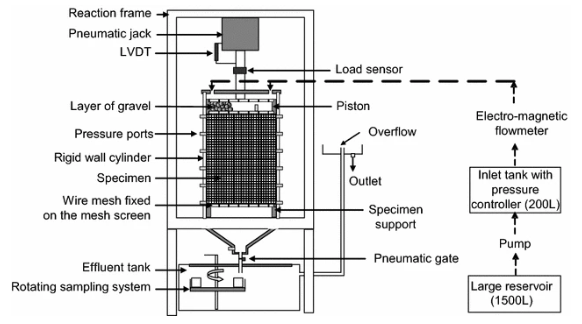
Title: A description of internal erosion by suffusion and induced settlements on cohesionless granular matter
Year: 2015
Content: This study investigates suffusion-induced internal erosion in cohesionless granular soils and its associated settlements. Through experimental observations and modeling, the authors demonstrate how selective removal of fines alters the internal fabric while the coarse skeleton remains intact. The study highlights the link between fine-particle migration, permeability increase, and progressive settlement. It provides important insight into the mechanical consequences of suffusion beyond purely hydraulic effects.
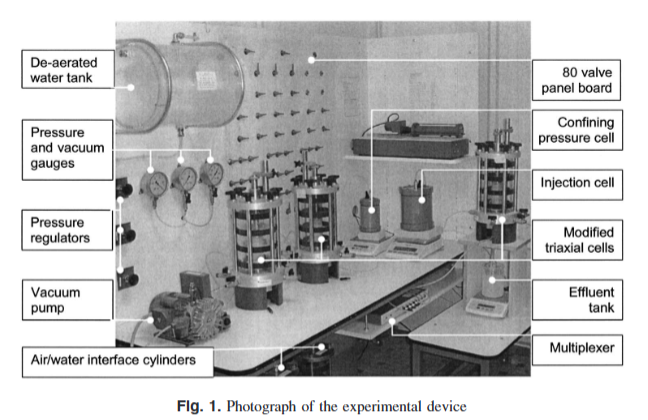
Title: Experimental parametric study of suffusion and backward erosion
Year: 2008
Content: This experimental study examines the influence of hydraulic gradient, soil gradation, and boundary conditions on both suffusion and backward erosion processes. The results show that grain size distribution and compaction strongly control the initiation of internal erosion. The paper clarifies the transition between suffusion (fine migration within a stable skeleton) and piping-type mechanisms. It provides valuable parametric data for validating internal erosion models.
Title: Assessing the potential of internal erosion and suffusion of granular soils
Year: 2011
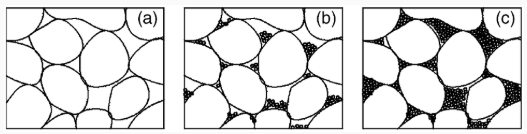
Content: This paper proposes a new empirical criterion for evaluating suffusion susceptibility based on the concept of bimodal soil structure. The authors introduce the controlling constriction size of the coarse fraction and compare it with the representative grain size of the fine fraction. A stability boundary is defined using a ratio, allowing classification of soils as internally stable, unstable, or transitional. The study provides a physically interpretable geometric framework for predicting suffusion potential.
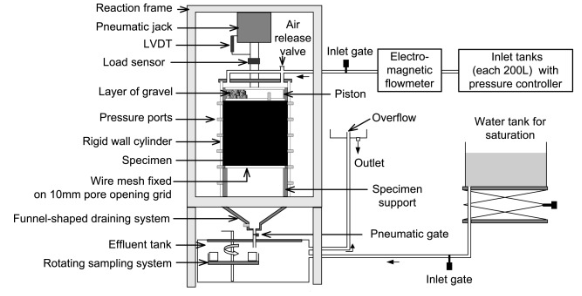
Title: Internal erosion by suffusion on cohesionless gap-graded soils
Year: 2012
Content: This study focuses on suffusion behavior in gap-graded cohesionless soils. Laboratory experiments demonstrate that fine particles can migrate through the constrictions formed by a coarse skeleton without immediate collapse of the structure. The research emphasizes the importance of gradation and constriction size in governing fine migration. The findings reinforce the concept of bimodal structure as a prerequisite for suffusion.
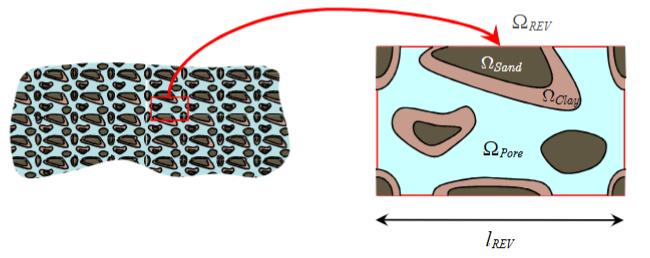
Title: Numerical modeling of suffusion as an interfacial erosion process
Year: 2011
Content: This study models suffusion at the pore scale as an interfacial erosion process occurring at the clay–water interface. A Stokes flow solver combined with a level-set method is used to track the moving fluid–soil interface. The results demonstrate how shear-induced erosion at the microscopic scale can reproduce macroscopic suffusion trends. The paper bridges the gap between continuum bulk erosion models and pore-scale interfacial mechanics, highlighting the role of the erosion coefficient in governing suffusion evolution.