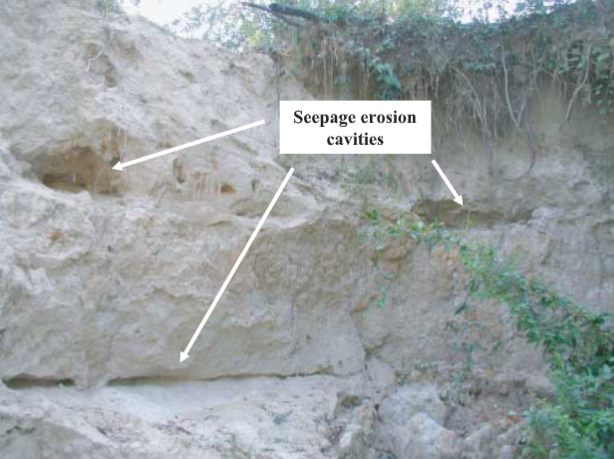
Title: Soil properties controlling seepage erosion contributions to streambank failure
Year: 2006
Content: This study investigates how soil properties control seepage erosion and its contribution to streambank failure in deeply incised channels. Field measurements and controlled lysimeter experiments showed that seepage flow through a conductive sand layer over a restrictive layer rapidly initiates sapping erosion, leading to significant bank undercutting. Sediment concentrations were strongly related to flow rate and layer slope, highlighting the importance of hydraulic gradients and stratigraphy. The results demonstrate that seepage erosion can destabilize streambanks through undercutting even before significant changes in effective stress occur, emphasizing the need to incorporate subsurface flow processes into bank stability models.
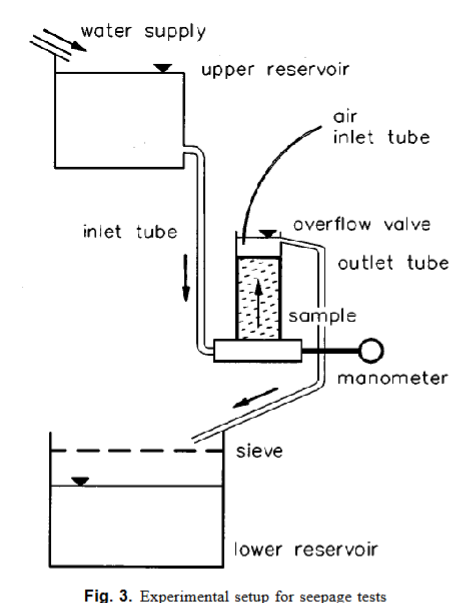
Title: Effects of the erosion and transport of fine particles due to seepage flow
Year: 2003
Content: This study investigates the erosion and transport of fine particles within granular soils subjected to seepage flow. The paper develops a coupled hydro-mechanical formulation to describe how the progressive removal of fines alters porosity, permeability, and mechanical properties of the soil skeleton. Results show that fine-particle migration significantly modifies the internal structure while the coarse-grained framework remains largely intact, leading to changes in stiffness and strength. The work provides a continuum-scale modeling framework for suffusion processes and highlights the feedback between hydraulic conductivity evolution and mechanical degradation.
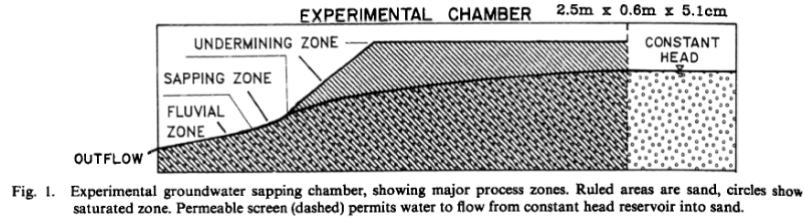
Title: Erosion of cohesionless sediment by groundwater seepage
Year: 2008
Content: This study experimentally investigates erosion of cohesionless sediments driven solely by groundwater seepage. Laboratory flume experiments demonstrated that upward and lateral seepage significantly lowers the critical shear stress required for sediment entrainment, even in the absence of strong surface flow. The results show that seepage modifies both hydraulic gradients and sediment stability, leading to enhanced detachment and transport of grains. The study provides quantitative relationships between seepage gradients and erosion rates, highlighting the important coupling between subsurface flow and surface sediment mobilization.
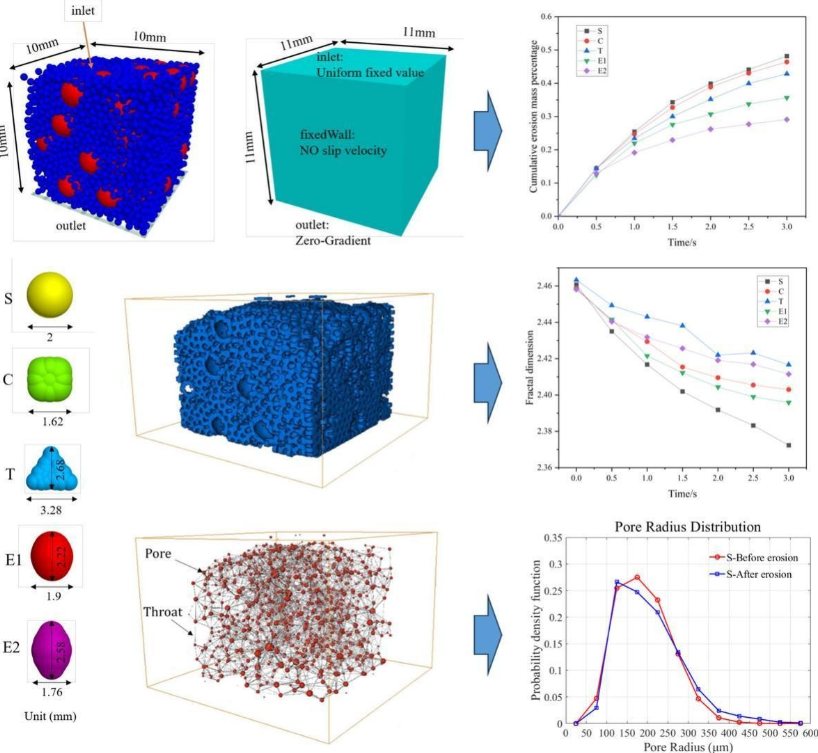
Title: A CFD-DEM study on seepage erosion and pore-structure evolution in gap-graded soils with irregular grain shapes
Year: 2026
Content: This study employs a coupled CFD–DEM framework to investigate seepage-induced erosion and the associated evolution of pore structure in granular soils. The simulations explicitly resolve fluid–particle interactions and demonstrate how increasing hydraulic gradients trigger particle detachment and progressive pore enlargement. The results reveal a feedback mechanism between particle loss, porosity increase, and permeability enhancement, leading to localized flow concentration. The work provides particle-scale insight into seepage erosion mechanisms and quantifies the relationship between hydraulic loading and internal structural evolution.